Fine Arts for Reparations
Public Space as Corrective
2026
Now we are here, and what I am building has become very clear to me.
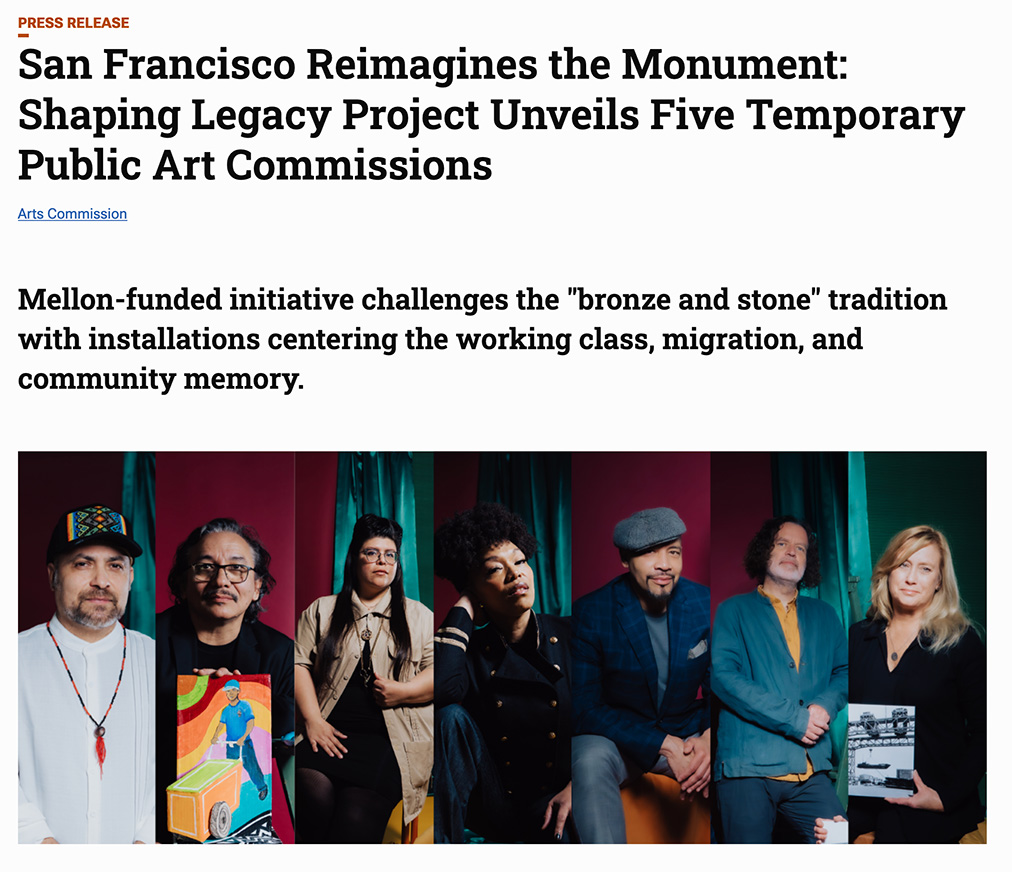
Through the Shaping Legacy Project — a multi-year initiative funded by the Mellon Foundation and administered by the San Francisco Arts Commission — my AR work is fully integrated into my monument practice. Memory Portal: 1945 is a hand-welded steel sculpture honoring the Great Migration families who came to work at the Hunters Point Naval Shipyard and built what we know as the Harlem of the West. It is temporary, on view in Bayview–Hunters Point from June through October 2026. And through AR, it opens.
You come to the site. You stand in front of the steel. And through augmented reality, you can access the people connected to that place — the labor that shaped it, the families who built their lives here, the truth that was never formally marked in any monument, any plaque, any civic recognition.
This is what it means for the story to be told by the people, for the people.
Traditional public monuments were largely built to tell the stories of those who held power — to cement their version of history into bronze and stone and set it in public plazas where everyone walking past would receive that version as fact. What I am doing is a direct counter to that tradition. My monuments don’t just stand. They open. They speak. They name names and explain policies and carry the voices of the people who actually lived the history being commemorated.
This is Fine Arts for Reparations. Not as a slogan. As a methodology.
Because Satisfaction — one of the five forms of reparations defined by international law — explicitly includes public truth-telling, memorials, and acknowledgment. What I am building is reparative infrastructure. It is monument-making as policy advocacy. It is the permanent, public, physical insistence that these lives happened, that this labor was real, that this community exists and has always existed, and that the erasure of that fact is a harm that demands repair.